

There is something wonderfully foreign about sitting in a XiaoLongBao restaurant at 6 a.m. in Shanghai reading Fear and Loathing in Las Vegas. In terms of geography, in terms of culture, in terms of epoch.
Thompson is iconic, less because of his writing, but more because he, himself, became a symbol - an unruly, oft high, mirrored-aviator-wearing, Hawaiian-shirt-swaddled, occasionally cross-dressing caricature of the unfettered pursuit of freedom which became synonymous with late 1960s Americana. By turning himself into a caricature, he was able to - quite effectively - portray how corrupt the caricature of the American dream had become.
To me, the post-covid timeline carries surprising parallels with the 1960s as a period of obvious cultural overhaul; perhaps the first real test of competing collective wills in thirty-plus years.
What should America become?
Instead of revolting against traditional gender norms, racial inequities, religious institutions, and almost any type of authority, the post-covid moment is a more Andreessen-vs.-Mamdani-vs.-Trump-pilled contest to capture hearts and minds (i.e. the timeline) ahead of humanity’s great inflection. Which cocktail of bottoms up energies can be harnessed to grasp the rudder as we splash into the oncoming rapids of the post-human epoch? Which tribe will be in command as we cede our monopoly on intelligence, harness the new means of production, and set the rules for a revised relationship with mortality?
There is, as always, the internal US struggle, and yet now, for the first time since 1991, there is an outside contender. An ascendant power plotting its own course into this unfamiliar future. As an American living in China, its easy to view the rivalry through the lens of Great Power competition: of technological, economic, and military supremacy. However, insufficient attention is paid to “vibes”: that amorphous collection of bottoms-up energies which evades quantitative measurement, but is - like porn - unmistakably recognizable.
I submit, currently, vibes in the US are better.
Trickle Down Vibenomics?
I have written on numerous occasions regarding China’s rise and strengths. Drive around any tier one city in China, and the 1950s bones of SF start to look like a tired backwater. China is close to the frontier of AI and biotech and undoubtedly leading in renewables and robotics. The convenience and quality at a given price point is world-leading. Soft culture is making inroads abroad as well: “Chinamaxxing”, bubble tea lines, DJI drones, Unitree robots, short form video apps and micro dramas, Labubus, XiaoHongShu refugees - all green shoots of Chinese Gen Z’s growing cultural exports. The slope of “vibal” appreciation over the last two years is tangible.
And yet the global moment is still very American.
A walk through a park in China is pristine landscaping and aunties line dancing. A scroll through Xiao Hong Shu is more polished micro-dramas and less JP Morgan sex scandal. A night of “fun” in Shanghai is increasingly tame Karaoke bars graced with predictably sad Chinese ballads and running mascara.
Perhaps it is politics. Perhaps it is demographics. Perhaps it is the real estate malaise. Perhaps its the culture. But there is no denying that the vibe of our current epoch is American. Frantic, charged, accelerating, k-shaped, entertaining, polarized, anxious, yet still, tentatively, optimistic. Unguarded techno-acceleration. AGI cults. Looksmaxxing. Space datacenters. The world’s first trillionaire. A reality TV star president. Bryan Johnson’s girl friend’s vaginal microbiome. An unnecessary war in the middle east.
Everything, all at once.
Despite the political polarization, corruption, cost of living concerns, rising multipolarity, and the uncertainty about the future, the post-covid U.S. vibes are surprisingly... elite.
Maybe its just big cities like New York and San Francisco and Miami. Maybe I’m gaslighting and out of touch. Maybe five years ago I would have been cancelled for even suggesting the term trickle-down vibenomics - but its mid summer 2026 and the vibes are.... pretty good?
Knicks open air watch parties projected on exposed brick in west village. Norwegian rowers commandeering Line 6. Polymarket agents placing bets on machine god releases from roof-top parties in the Haight. A playful excitement is afoot once again. Maybe, as some remark, it’s the flailing rasps of a decadent late stage republic in decline... maybe its just the world cup... maybe its the honeymoon period of post-woke liberation...
But I don’t think so.
As opposed to Europe, the chaotic, unwieldy, unpredictable and lopsided energy in the US feels more like rebirth than collapse, the optimism and anxiety of an epoch in flux. The infighting still exists, but the stakes are higher now. The horizons elevated. The debates worth having. The distribution of outcomes blown open.
China is increasingly trying to be the adult in the room. Trying to put a lid on it. To manage the transition. To weather the “100 year storms.”
America, for better or worse, is embracing the chaos.
Since her founding, the US has been synonymous with the frontier. A magnet for pilgrims willing to risk the unknown. A protestant society testing their proximity to God through productive capacity, unraveling his secrets, and now - at the limit - increasingly trying to build their own.
China is the platonic elite asking “why” and implementing “how”. America is the ungovernable diaspora asking… “why not?”
The Dragon and The Eagle
As I have written, and Tanner Greer has poasted, Americans and Chinese are more similar than they are different. Both societies are highly commercial, practical, competitive, like big houses, big cars, are tech-forward, have “big country autism,” relatively high in risk appetites, and are hard working.
To me, the biggest underlying difference appears psychological. While most Chinese folks I speak with seem generally convinced of China’s continued ascension, they also tend to be more pessimistic individually. It can be seen in the savings rate. The “lay flat” movement. The demographic decline. The Gao Kao, the 1000 Groupon wars, the “involution”, the lack of social safety net.
China is the ultimate Darwinian arena for memetic competition at almost any level. The unending treadmill to stay in place. This hypercompetition breeds determination, resourcefulness, and perseverance. It also breads anxiety and existential dread, as comes through quite evidently in many s-tier poasts from Chinese netizens.
When I ask my non-American wife what her favorite thing about America is: her answer is both cliche and true, “the optimism.”
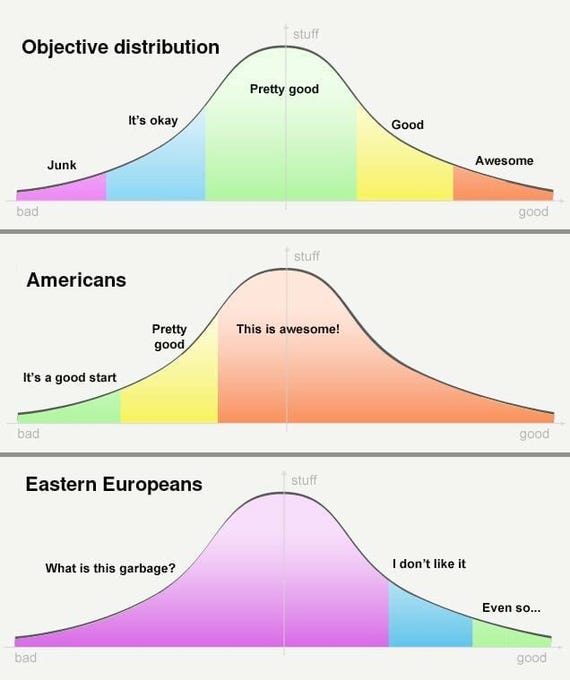
I, too, find it one of the most attractive character traits in the American DNA: a positive sum view of the world that made America a technological super power and, historically, made her a uniquely benign hegemon.
Clearly, though, America is reconsidering its role in global affairs.
Yes, but they are OUR SoBs
Globalization is an easy whipping boy after the end of history. The clear feeling of over-extension to the point of national security vulnerability which requires drastic action. For a rich country like the US, with an inflated reserve currency impacting its competitiveness, the only real option to reshore amidst global capital flows is a healthy dose of mercantilism and a high degree of automation.
Yet, after decades of unequal outcomes, American leaders have an uphill climb in convincing median voters that AI will be a boon for wages versus a second, even more existential “shock” with K-shaped implications. Trump’s takeover of the Republican Party and the ascendent “DSA” within the Democratic establishment are clear signs of discontents with traditional liberal policy.
These challenges in liberal governance are compounded by demographic inversion.

Aging democracies vote unsustainable benefits to older cohorts... which raises the debt load... which requires money printing to cover the hole...which raises the cost of living for everyone without assets... which drives populist political successes.... which promise more benefits to assuage rising discontents...
The paradox, of course, is that technology is both essential to American reindustrialization and yet also seen by the median voter as another accelerant of inequality. Chinese society is now significantly more optimistic than the US regarding technological progress.
So how do elites sell unpopular, nation-state-sized investments in automation to a scared, median voter?
“Chyna.”
America Is Obviously Going to Do the Thing
The ghost of Hunter S. Thompson is alive and well within the American electorate. She is skeptical of most forms of centralized power - whether it be in the form of her own government, the ever-ambiguous, yet derided “elites”, or the rising AI oligarchs.
However, the one thing she fears more is falling behind.
America can stand positive-sum games but only when it is the clear #1. If the choice is between slowing down or falling behind, the course is obvious. The capital will flow. The political-will corralled. The GPUs will hum.
One of the most interesting critiques of my latest piece on automation, multipolarity, and demographics was that it didn’t go far enough. It failed to make the leap to a world in which humans are no longer the principle agents. Where agents become central actors within a previous drama. Where 10,000,000 GPU models begin to fuse with the state and slowly, imperceptibly, make policy and resource allocation decisions.
This is a fair critique, yet one I believe, counter-intuitively, is more representative of the US than China.
After its century of humiliation, Beijing is investing heavily in the “rejuvenation of the Chinese Nation:” making strategic investments which will reduce external dependencies, accelerate competitiveness, and advance national power. However, because of that same history, its north star remains stability and control under the CCP. Like capital, I expect AI to remain firmly subservient to the state in China.
In the US, though, this relationship appears poised to evolve differently.
America was built by individuals who risked the frontier to build a new type of country and succeeded wildly. Perhaps the US is destined to lead the world in AI because it has just enough of a competitive threat, just enough optimism, just enough wonder, and just enough hubris to roll the dice.
Perhaps you could say America has just enough faith.
Sitting at my XLB shop in Shanghai, I feel life will get a bit better each passing year, somewhat shielded from the volatile winds of history. For a man with a two year old and another on the way, this has some appeal. But visiting rooftops in Pac Heights, the tension of the moment is more palpable; the apocalyptic foreboding and playful exploration of dancing on the edge of something steep, on the way to a summit of unknown heights.
Perhaps the moment feels more American, because it is.
Rawson is an early stage investor in AI, robotics, and frontier tech at Delphi Ventures.
His and the broader Delphi team’s writings can be found at Delphi Intelligence, Delphi Ventures, and Delphi Digital.
He can be reached on x.com @PonderingDurian
.