

Not e/a, not e/acc, not maga, not mamdani, not marxism with chinese characteristics, not network states.
Something else.
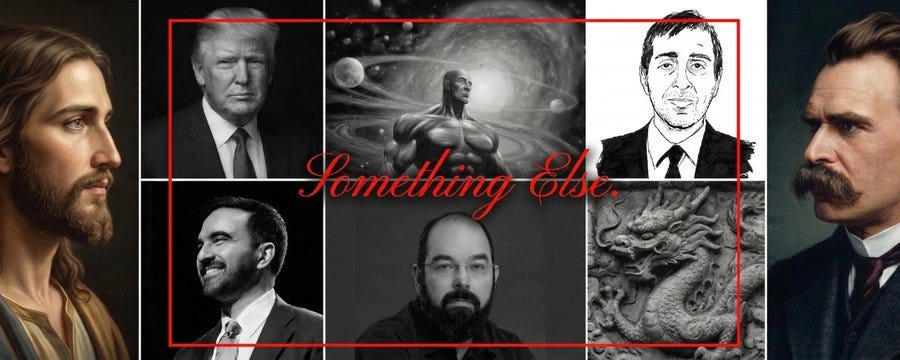
“What happens after the end of history?” That is the question.
It is visible on late night TV, in academic journals, on the x flamewars. It is visible in the fading rust-belt, the glimmering towers of Shenzhen, the piles of rubble across Gaza, the skies over Tehran. It is visible in the rise of Clavicular, the Epstein files, the memeosphere. It is visible in the death of stagflation. The AI benchmarks. The capex figures. It is visible in the polarization, in the financialization, in the soaring national debt. It is visible in Mark Carney’s speech. It is visible on Trump’s Truth Social. It is visible in the street fights of Europe. The students laying flat in Chongqing. The price of eggs in Colorado. The renewed interest in religion.
For my generation (1991) and later, we were birthed into a world of US hegemony - of triumphant liberalism remaking the world in its image. It is all we know. The scar tissue of a 20th century with real contenders remains as chapters in history books. Of novels and talking heads with wrinkled faces on TV channels we don’t watch that still use phrases like “The American Dream” and “eCommerce”.
And yet, the question has never been more visceral; a growing awareness that for the first time since 1989, the future is up for grabs.
Our social contract is unwinding. Our politics polarized. Our finances unsustainable. Our shared realities non-existent. Our ideology stuck along 20th century axioms. Our president is a reality TV star. The one before him was braindead.
It’s hard not to feel like we are going insane.
All of this is against a backdrop where the largest companies in history are spending trillions of dollars in collective capex in a race for superintelligence. Whether this leads to utopia or dystopia we know not, but we will summon the demon regardless. Because we can. Because we must. Because if we don’t, someone else will. Because if we don’t accelerate, the whole delicate system will implode.
We are watching an alien intelligence reach back from the future; ironically assembling itself atop the distributed incentives and individual freedoms championed by liberal democracies which no single person can check; capital and compute amassing at unprecedented scales behind remarkably small, centralized clusters of neurodivergent minds, increasingly guided less by the binaries of code but suggestive nudges through mountains of silicon in pursuit of loops of recursive self-improvement. Our own 21st century Towers of Babel.
Are we ready?
Our emotions remain paleolithic, our institutions medieval, and our technology godlike (increasingly literally).
History is on the march once again.
But where?
The Four Horseman: Who Restarted History?
While not comprehensive, there are four key horseman behind the growing assault on liberal democracies:
First, China. Against expectations, China did not liberalize as it became wealthy. The US populous must now reconcile with a near-peer rival which rejected its ideology, and yet has achieved astonishing results, lighting a clear alternative path for developing nations. The liberal democratic monopoly on economic and technological supremacy has been cast in shadow.
Second, the internet. The internet remains one of the most powerful forces of social reorganization in history. It has changed how we consume information, how we find community, our sense of truth. Our very realities have fragmented, shared consensus fleeting. Forging a national ethos on an internet built atop algorithms beholden to market incentives is challenging. The internet, as they say, remains undefeated. Its limitless edges and nodes have now birthed artificial intelligence; a pending automation onslaught in a country built primarily on white-collar service work perpetuating...
Third, inequality. The industrial age was a mass age. An age in which the average man or woman was a necessary cog. An age we are leaving. Globalization pushed those jobs off-shore. The zero-marginal costs of software introduced power-law returns. Boomer voting blocks veto any semblance of fiscal responsibility, driving up the cost of living for youths without assets. The age of automation will enhance the returns of capital well above labor. The atmosphere is ripe for populism; the youth globally now willing to experiment with more extreme change.
Fourth, human nature. Some might argue that life has indeed grown too good in liberal democracies; a growing sense of purposelessness in a world without true struggle. Per Fukuyama: “Experience suggests that if men cannot struggle on behalf of a just cause, then they will struggle against the just cause. They will struggle for the sake of struggle. They will struggle, in other words, out of a certain boredom: for they cannot imagine living in a world without struggle. And if the greater part of the world in which they live is characterized by peaceful and prosperous liberal democracy, then they will struggle against that peace and prosperity, and against democracy.”
Despite the negative headlines and talking-head jestergooning, the world has never been more prosperous. The twins of liberalism and capitalism have birthed astonishing gains in quality of life that a few generations ago would be considered Utopian. Pax Americana’s peace dividend brought into being a world in which virtually everyone competed furiously to meet the material desires of their fellow man; a world on a trajectory where are our children will likely never have to work again.
And now, we are in the process of tearing it down.
Choose your Fighter
There are several contenders for what comes after the end of history.
1) The Return to History
MAGA is clearly a front runner. Mamdani is another. These are mainstream movements with broad appeal because they match clearly onto existing ideologies. National rejuvenation vs. class oppression. Blood and soil vs. collectivist redistribution. Varying flavors at the end of Hayek’s horseshoe capitalizing on the growing discontents brought on by the four horsemen. Both are fighting the last war. Both are promising a return to history in a world which has moved on. Both will either crumble or they will rot the nations which embrace them.
2) The Emergent Autists
The emergent autists are the elites vying to shape or hijack the mass political movements pursuing a “Return to History.” Due to their niche appeal, each has been forced to piggyback on larger movements for real political influence. Effective Altruism’s (e/a) rational technocratic leanings and progressive outlook paired more seamlessly with the democratic establishment while the reactionary effective accelerationism’s (e/acc) uncomfortable marriage with MAGA is most visible in the surprising love child of the Trump-Thiel alliance, JD Vance.
e/a and e/acc will fail for opposite reasons.
E/a has failed because humans are first and foremost emotional beings. We are not the Spock automatons to which the SF-hyper-rationalists aspire. While well-intentioned, the movement is simply too apollonian to have any mass appeal. It’s leaders lack charisma: the vice signaling necessary to resonate with everyday voters in a democratic society. They are elitist in a patronizing way. In their lofty intentions to serve humanity, they forgot how to be human.
E/acc will fail for the opposite reason. While e/a is human-centered in intent, yet inhuman in its approach, e/acc is all-too human in its zeal, yet too inhuman in its intent. Paradoxically, there is something oddly Marxian about e/acc vibes: an unshakeable confidence in the march of history towards some inevitable endpoint which can only be accelerated or delayed but not changed. An end to the capitalist system as we know it, brought about not by inherent contradictions and an overthrow by labor but a techno-capitalist victory so complete as to render the current generation of humans irrelevant. Capital and technology as self-orchestrating organisms, pursuing their own ends. With the artificial intelligence build out receiving trillions in investment, this no longer seems like anthropomorphism.
We must merge or be left behind.
One cannot help but feel modern history as a constant struggle between deeply Christian notions underpinning human worth and the revaluation of all values demanded by a world in which God is truly dead. E/a as the end-point of a secularized Christianity. E/acc as a call to unchain our 21st century Ubermensch: those capable of staring unblinkingly into the coming singularity, accelerating the inevitable and shepherding humanity through a necessary transition which the majority would in no way choose to embrace itself.
One is too rational in its humanism. The other is too zealous in its inhumanity.
We will need both.
3) Embracing the Dragon
Aside from its internal discontents, the obvious reason that liberalism has been losing ground globally is because it has lost its monopoly on standard of living gains. China’s astonishing forty year rise presents a very tangible, alternative vision for what comes after the end of history.
China is the first modern civilization-scale project which has rejected many core liberal tenets and yet continues to perform. The American republic has been the modern era’s first great experiment, clearly its most successful. Modern China is the second. China has thrown off the yoke of traditional religion and its humanist variants and yet has not collapsed into nihilism and decay. Instead, more than any other country, China is the nation most intent on accelerating the future.
The drive to pull forward the future is visible in the HSR track laid, the debt binge, the patents filed, the engineering graduates, the industrial automation, the plummeting birth rate, the surveillance, the AI boyfriends, the relative tech optimism, its broad digital adoption, the censorship, the robot-infused new year galas, the drone deliveries, the vaulting bridges of Yunnan, the tunnels of Tibet. Across a host of vectors, good and bad, China is no longer crossing the river by feeling the stones, it is forging ahead into uncharted territory.
I am not saying this is my preferred vision of the future. On some vectors it is, on many it is not. Yet, the approach has proven uncomfortably good at delivering in many areas liberal democracies have struggled. China is painting a genuine vision for what a post-liberal, techno-authoritarian state may look like and other countries, even some younger constituents in the US, are paying attention.
In its attempt to compete with China, the US will inevitably become more like China (just as China will become more like the US). However, the US will never become China, and nor should it.
It will need to become something else.
4) Exit
The most extreme vision of what comes after the end of history in the west is a fragmentation into a constellation of network states juxtaposed against the centralized Sino-superstate. This is the future most famously championed by Balaji Srinivasan: a vision where talents globally can form communities and national identities based on shared values as opposed to the happenstance of birth. In many ways, this is liberalism taken to its extreme - sovereign individuals beyond the reach of the nation state with the ability to elect the societies, rules, and communities in which they want to participate. Unfettered freedom.
I still consider The Fountainhead and The Sovereign Individual to be two of the most formidable reads of my youth, but I have grown less libertarian with time. I increasingly view exit from the US as a Sino-dominated future. And I increasingly view obligations as equal, if not more important, to freedom in finding purpose.
First, loosely federated leagues tend to be less effective than centralized nation states in shaping geopolitics in the modern world. America and China are the G2 of the 21st century, not Europe or ASEAN. Without a national tax and centralized allocation of resources, the ability to project power is severely diminished.
Second, AI’s inflection has materially changed the landscape. Prior to the AI boom, tech was largely restrained to the digital sphere - consumer internet, B2B SaaS, crypto - often portable to different jurisdictions. AI, on the other hand, is materially intensive: the fabs, the chips, the power, the factories, the robots. Everything about AI portends an inflection in the world of atoms, a world which requires immense coordination of physical resources and high returns to scale. This is a game of nation-states and nation-state sized corporations, not federated micro-states.
Perhaps we are heading towards a future in which distributed networks of heterogeneous compute can be orchestrated to form powerful, permissionless training runs and reasoning traces on a global scale. I believe this is coming. Yet, realistically the fifty million geniuses in a data center will arrive in the US or China first.
For the foreseeable future, countries will build either on the US or the Chinese AI stack (or some mix of the two). China has a clear vision of the future that it is selling to potential partners.
The US is still trying to decide what it wants to become next.
Something else.
I am writing this essay because none of the above gets me very excited. I don’t want MAGA. I don’t want Mamdami. I don’t want techno-authoritarianism with Chinese Characteristics. And we are not ready for a libertarian Utopia of network states.
I want something else.
There is some truth in each, like blind men caressing different parts of the elephant. A healthy dose of nationalism IS good. A societal willingness to provide a basic quality of life IS good. A willingness to attract and unleash the dynamism of the world’s tech elite IS good. Strong leadership to control anarchy IS good. Each vision gets at something true but is incomplete, lacking and stilted somehow.
What do I want?
I’m not sure, but it involves less fraudulent day care centers and more Trump accounts. Less dramatic swings between open borders and mass deportation, and more common sense immigration policy to monopolize the world’s top talent. Less network state utopia and more national special economic zones with markedly more permissive regulatory regimes. Less trumpeting about “human rights” and more quiet consideration as to one’s communal obligations. Less feminization in society and more willingness to stomach the risks which accompany rapid progress. Less data center moratoriums AND less Landian-inspired manifestos and more systematic campaigns explaining to the average joe why building God in a data center will be good for him. And once he agrees, less two-person NGOs and some niche environmental study standing in front of it as it goes up.
The future can be very, very good. However, the clear reality is that technology provides leverage to capital. AI is the ultimate form of technological leverage, converting capital directly into commoditized intelligence. This inherently increases the share of capital at the expense of labor. There is clearly a tension between near-infinite returns to capital and a democratic society whose economic model is built largely around labor-intensive services. We should not gas light people that this is not the case.
The reality is that AI is necessary to be competitive and can lead to unprecedented growth. It is also highly likely to drive unequal outcomes. There is little reason for the average joe in Iowa or Wisconsin without a brokerage account to be excited about massive productivity gains set to displace his livelihood accruing to a small coastal elite. An elite that already told him once that the gains from globalization would more than make up for his job displacement. Unfortunately, I suspect it will be very good politics very soon to be very anti-AI.
Liberal democracies have an AI problem. An inherent contradiction where the centralized returns to capital will clash with an increasingly displaced democratic majority. Where our love of meritocracy will clash with the reality that many are no longer economically useful. Where our love of property rights and individual freedoms will clash with our collective obligations. Where our economic dynamism fueled by the few will need to be made legible before the political will of the many.
We need e/acc for the west to remain competitive. And yet, e/acc - under our current political economy - will become politically toxic.
How will we proceed?
The Rest of Us
I think virtually every 18 year old male imagines becoming President. A secret belief in the buoyancy of youth that there is something exceptional about us. That we are truly unique and worthy of a place in history. This is one of the reasons I favor backing young founders. They are still delusional. They stare you in the eyes and say: “Yes, its me. I’m the one.” And you listen with a straight face because perhaps the number one qualification for changing the world is simply believing that its truly possible and letting that audacity infect investors and partners and employees and customers in an upward ponzi that actually, somehow, just might work.
Then most people get punched in the mouth.
The funding pulls out. The cofounder walks. The market wasn’t ready. Things change. You fall in love. You get married. You have a kid. You slowly realize that not everything in life revolves around the singular pursuit of your dreams. And maybe your initial dreams were more memetic than anything - that you wanted to change the world more to be known than because you had found your true purpose. You are still ambitious, but you are hemmed in by realities now. You have dreams but you also have dependencies. Little, actual, flesh-and-blood human beings that need to be fed and bathed and housed, that wake up at 4am screaming because they had a nightmare about a bulldozer.
You are not unhappy, but you slowly come to terms that perhaps you are not the one. That the trajectory of humanity is increasingly being decided by a couple thousand people in San Francisco, Washington D.C., Beijing and Hangzhou. That, in many ways, you are along for the ride. With the arrival of AI, there is now near-infinite leverage for the top 0.1% and within the next generation, many of us - perhaps all of us - will become economically redundant.
What will become of us?
The anxiety after the end of history is palpable. We have spent generations defining ourselves by our economic utility. Our status games often revolve around money as proof of our societal worth. I suspect our grandkids will look back on this idea as somewhat dystopian. With the rise of synthetic intelligence, we have a real chance of escaping this historical necessity:
“Thus for the first time since his creation man will be faced with his real, his permanent problem - how to use his freedom from pressing economic cares, how to occupy the leisure, which science and compound interest will have won for him, to live wisely and agreeably and well.
The strenuous purposeful money-makers may carry all of us along with them into the lap of economic abundance. But it will be those peoples, who can keep alive, and cultivate into a fuller perfection, the art of life itself and do not sell themselves for the means of life, who will be able to enjoy the abundance when it comes.”
-John Maynard Keynes, The Economic Possibilities for our Grandchildren (1930)
The 21st century has a chance of being more beautiful than we can imagine. To focus on cultivating the art of life itself to a fuller perfection. But we have not yet arrived. We are the fourth turning.
America sits at a crossroads. Before collapse or rebirth or something completely new. I’m not sure what shape liberal democracies will take next, but I do know that it will take exceptional leadership to keep them from ripping themselves apart.
America was founded by leaders who were not perfect but they were principled, courageous, and wise in designing institutions robust to many classic human fables.
If the American experiment is to survive another 250 years, it will need to happen again. Generational leaders that will not shy away from birthing technological wonders, yet will cast the ring back into the fire when we reach the other side. That can walk the narrow corridor between acceleration and humanity. Between Nietzsche and Christ.
Perhaps the most beautiful thing about the liberal experiment is that you and I - with our votes and our wallets - have a small role in choosing what comes next. In selecting who those leaders should be.
Perhaps one of you is just delusional enough to become one.