

The AI backlash is coming. It’s obvious, and, near term, I suspect there will be very little which can change it.
Shockingly, the “there is a 25% chance that everyone dies and yes, your electricity bill may be increasing, but we will automate your job” pitch has not been working with swing state voters in Iowa, Wisconsin, and Georgia.
Anti-AI politics is becoming obvious and will be a big part of the blue wave in 2026 and 2028.
I’m an odd person to write an anti-AI populist article because I’m incredibly bullish about the future. Occasionally, when he is handing me the broken orange monster truck which has now been dubbed “Daddy’s,” I look at my two year old son with a not insignificant degree of envy; an envy born of the acceleration over just the last four years.
I suspect he will never have “a real job.” I suspect he will have abundant leisure time. I expect he will have a longer, healthier life. I expect he will travel to other planets. The ever-humming GPUs will do his tedious desk work. The humanoids his manual toil. He will spend much of his time playing status games with limited, perhaps inverted, relationships to economic utility. Across almost any vector, I expect his life to be meaningfully better than my own.
This makes me deeply happy.
I don’t buy the “humanity-will-implode-without-the-dignity-of-work” argument. Most people I know don’t want to sit in traffic toting people to and from the airport 12 hours a day or pretend to be excited when a stranger walks into a retail establishment. At the very least, I expect “the work” to be different a point of non-recognition: like an 19th century smelter observing a 21st century You-tuber.
The weird part is, I actually think most of the unwashed masses are tentatively excited about the technological acceleration unfolding and a “post-menial-work” future. It is the elites behind the acceleration they do not trust.
Rights & Obligations
If the 20th century was dominated by the question of human freedom and individual rights, I believe the 21st will be decided by our collective obligations.
To whom - if anyone - are you beholden?
Capitalism outcompeted communism because it had the right model of the human condition. Humans, at their core, are selfish. Capitalism harnessed those incentives; roping the most ambitious among us into status games competing for who could better meet the needs of others - at scale.
Instead of Alexander the Great toppling the Persian Empire, we have Elon Musk providing you telecom service from space. Instead of Napoleon’s regiments marching across Europe, Bezos’ couriers deliver you eCommerce parcels in hours.
The institutions which allowed for this inversion are ingenious. Markets to enslave the titans of every generation in service of the masses. Democracy requiring the consent of the governed.
The results have been staggering:
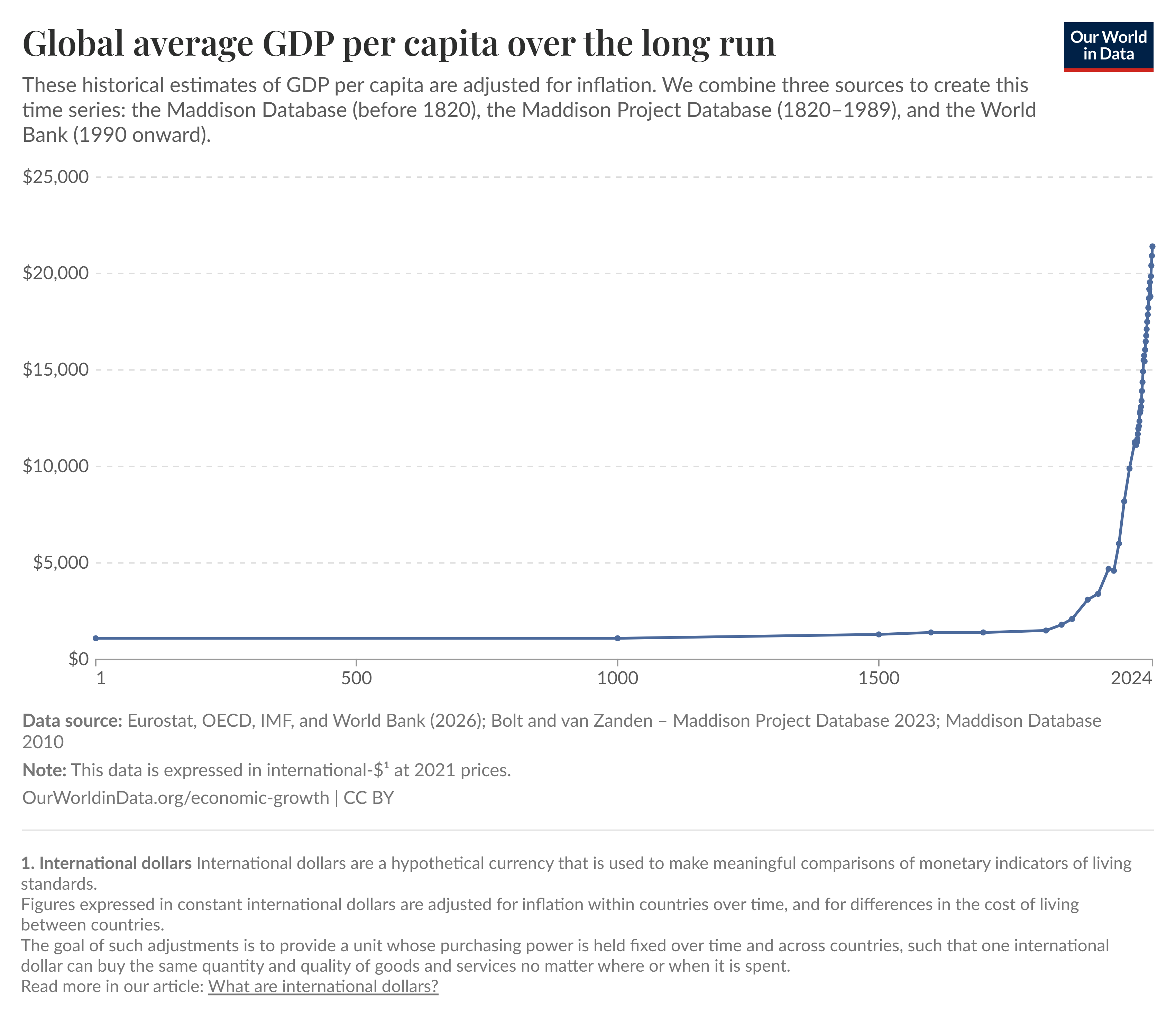
Not only did we align elites, politically and economically, with the interests of the broader populous, but structurally, the industrial revolution required a negotiation between production’s competing economic inputs - an interdependence between capital and labor which proved symbiotic to the point of undermining Marx’s prophesies of global proletarian revolution.
You couldn’t make a Model-T without a line of factory workers. You couldn’t sort packages without warehouse workers. You couldn’t deliver food without drivers. Productivity increased. Wages increased. Taxes increased. Worker protections rose. A more generous welfare state filled the gaps.
However, this equilibrium appears ever more fragile.
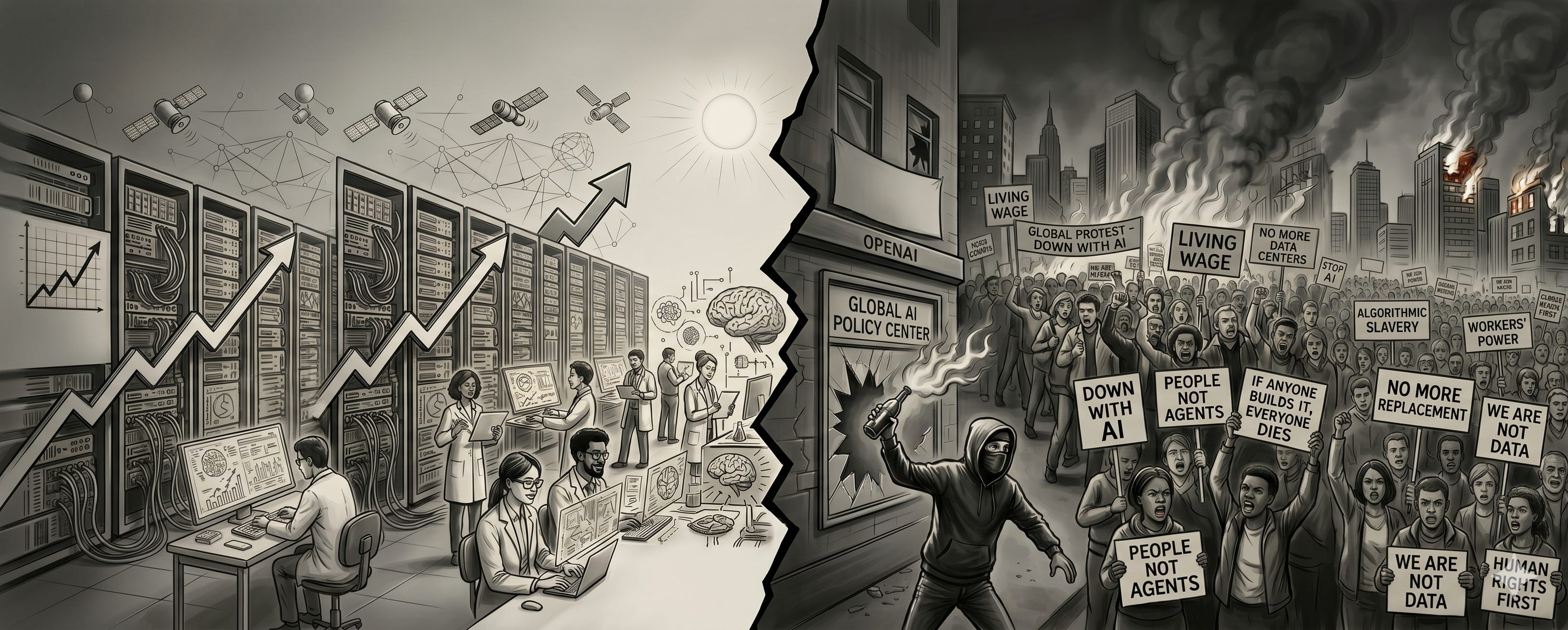
The bottom half of the K-shaped economy is realizing this interdependence is starting to fray: that their alignment with and leverage over the upper echelons of society is waning.
Transcendence & Distrust
We are entering a technical inflection where transhumanist sci-fi is becoming reality. Neural nets are now measured in GPUs as opposed to synapses. Humanoids are joining factory lines. Brains are merging with silicon. Drones are taking out regiments and delivering coffees. Genes are being edited. Webpages cater to agents over humans. Change on the scale of centuries will be compressed into decades.
We are becoming something else: as a society, as a species, as individuals.
In my opinion, this will be incredible.
Yet, many outside of the small pockets in San Francisco, New York, Hangzhou, and Shenzhen are rightfully beginning to wonder about their place in this rapidly approaching future. Whether the Landian agglomeration of GPUs and gas turbines and terrafabs has a place for them? Whether the increasingly remarkable ambitions of capital will serve them or replace them? Spurn them or pity them? Or, perhaps worst of all, prove indifferent.
Despite the AI labs beginning to make the right noises around “transition plans” and “broader distribution” and “machines of loving grace” the noises tend to be secondary: falling behind the incentives, the game theory, the national security concerns.
The researchers at the leading labs are brilliant. They are the top .001% intellects of humanity. Many aim to bestow a gift on the rest of humanity. But in honest moments at a Hayes Valley house party after one or two hard Kombuchas’, the conversation inevitably shifts to “securing the bag,” “escaping the permanent underclass,” and which “slice of the universe” each is eyeing.
The rest of us know this intuitively. We are skeptical of giving small groups - even self proclaimed “effective altruists” - deep reservoirs of power over us. That deep down, human nature is not altruistic. That fear is often a more powerful motivator than love. That without some sort of higher power - democratic institutions, religious observance, etc - individuals tend to be corrupted by power.
This is what it means to be human.
The masses are starting to feel this disconnect. An unwinding of the bonds which once chained these elites to us. Our shared humanity giving way to k-shaped diversions between transhumanists and underclass. Civic obligations giving way to the unchained Ubermensch.
This is unfair.
Right?
Moral Ambiguity
For nation-states to survive, mutual obligations need to be enforced. This can be a top down monarch or platonic elite which strives for uncorrupt, altruistic management - though all too often falls short - or it can be in the form of bottoms up social / religious norms - though all too often falls into anarchy.
John Locke - the father of liberalism and arguably the most important influence on America’s founding fathers - cleverly threaded the needle, recasting individuals from subjects to citizens, imbued with natural rights protected by a limited government requiring their consent. Yet, the foundation of these rights is explicitly religious. “We hold these truths to be self-evident, that all men are created equal, that they are endowed by their Creator with certain unalienable rights, that among these are life, liberty, and the pursuit of happiness.”
Paradoxically, the inalienable rights which secular liberalism prizes so dearly today are descendants of a religious belief system likely considered outdated and intolerant by modern liberalism.
Nietzsche, most famously, called out this contradiction. If we are endowed by God with inalienable rights, and God is dead, what happens to these rights? Who enforces our mutual obligations? Why should we be beholden to them?
Many are beginning to worry that perhaps Musk and Altman and Dario and the other neurodivergents sitting atop silicon thrones are not beholden to them. That, absent an increasingly fragile political infrastructure, they have no recourse. Perhaps the even more fundamental question arises for secular liberals in an AI era: on what foundations do we justify these obligations in the first place?
The economic interdependence is fraying. The moral justification is eroding. Increasingly, the remaining tool in democratic societies to constrain the elites is the ballot box.
They are going to use it.
Less Deceleration, More Diffusion
I’m a techno-optimist. To me, the answer is not the “data center moratorium” which appears more likely as the AI backlash ushers in a blue wave in 2026 and 2028.
It’s abundantly obvious technological progress has been a massive net boon, freeing up ever greater swaths of humanity to move from subsistence-level existence to the higher rungs of Maslow’s hierarchy where human flourishing begins. I believe the tools and capabilities which are being birthed today will lead to wondrously better lives for people alive today and for our children.
The question before us is not whether technology is a net good, but whether the gains from acceleration can diffuse quickly enough into the broader population to receive political buy-in from the electorate or will the concentrated nature of the gains lead to a backlash which retards it significantly.
So far, the monetary gains from the AI revolution have been quite narrow: accruing to a handful of equity holders at a handful of companies - many in the private markets in which retail investors cannot even participate. At the very least, the current market structure aggravates the yawning divide between asset holders and those forced to compete with synthetic minds approaching the cost of electricity for their daily bread.
The U.S’ current trajectory of monster corporations pouring trillions in capex into data centers to automate human labor is economically optimal and politically unsustainable. The US’s rival AI superpower, on the other hand, has focused more on broad AI diffusion as opposed to a relentless pursuit of the frontier. These “AI+” initiatives aim to inject low-cost, commoditized intelligence into large swaths of the economy, often those underserved by market incentives (i.e. accessible healthcare, more effective education in rural areas, smarter city management, more efficient industrial production for greater exports which can then be redeployed back into world class infrastructure, etc). I believe this emphasis on diffusion is one of the reasons the Chinese public appears much more receptive to an AI transformation than their US counterparts.
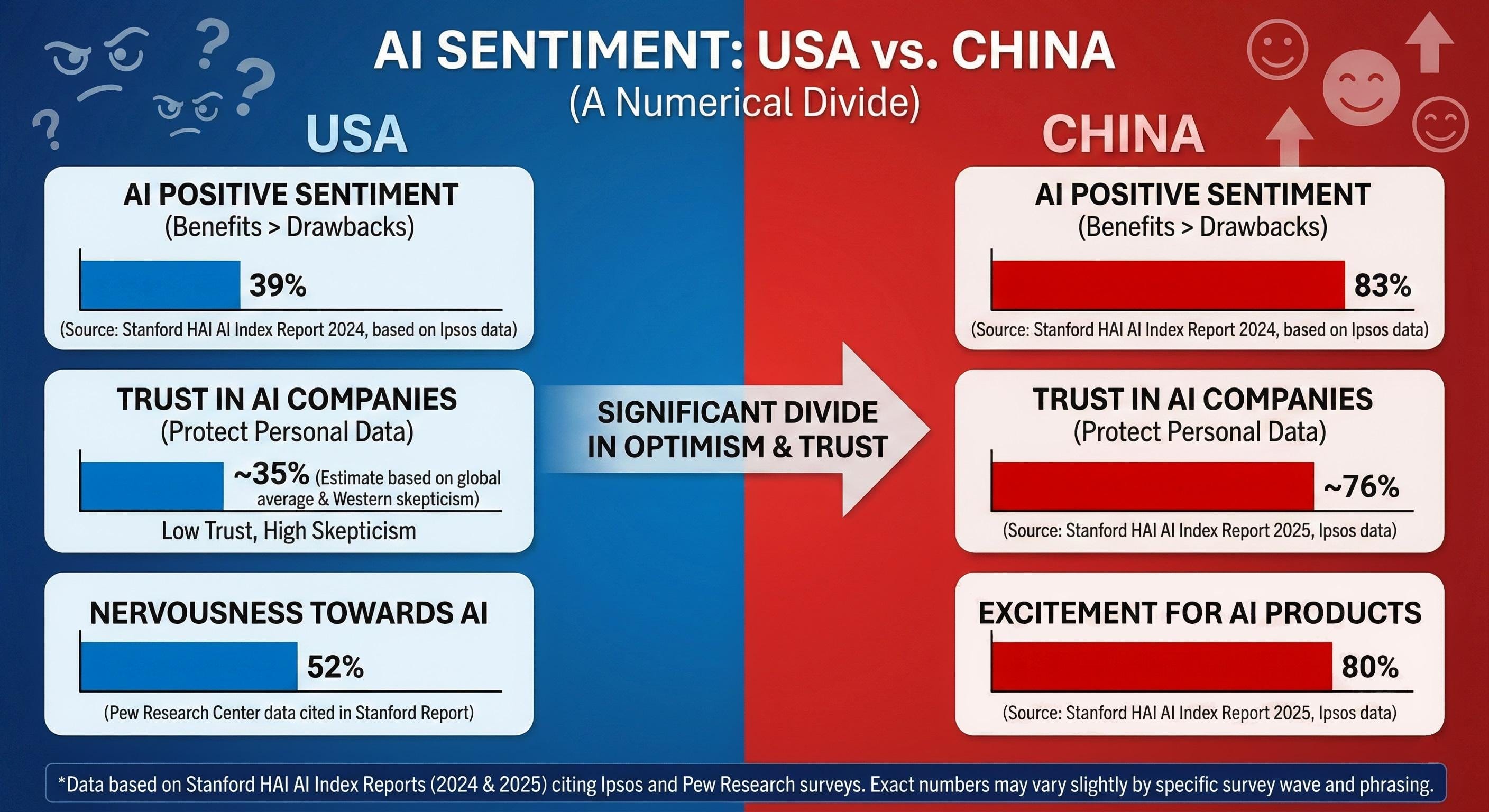
Source: Stanford HAI AI Index Reports
This is something the US should emulate.
My argument is not that the US should copy China’s approach. By all means, the U.S. private sector should continue to push out the frontier. My argument is that the private sector’s ability to continue pushing the frontier will be constrained not by economics but by politics. That without a clear agenda which translates these productivity gains into broader societal wins, the acceleration will grind to a halt at the ballot box.
We need to do both.
The current market structure of AI is built around the scaling laws and power laws. The largest compute clusters with the most data and the most power can produce the most frontier level intelligence currently capturing the vast majority of value.
As opposed to “data center moratoriums” or passively accepting massive, centralized AI cluster oligopolies milked for redistribution and allocated by political favor - is there a way to actively shape a market structure for less concentrated outcomes? Or, at the very least, can we be more proactive in leveraging these amazing tools for public benefit?
A few off-the-cuff examples:
Should we subsidize open source labs in the US to ensure affordable, open alternatives for US enterprises?
Should we DOGE for fraud and use the proceeds to implement our own AI+ initiatives staffed with new agencies with salaries benchmarked to the private sector (Singapore style) focused on implementing AI in healthcare, education, reindustrialization and more?
Should we not be taxing income lower than capital gains?
Should we begin a Universal Basic Equity program for newly born US citizens to give everyone a stake in the system?
Should we tax inheritance above US$1b at 100% and distribute the proceeds to said UBE pool?
Should we allow today’s deca-billionaires to distribute the financial gains from their company shares to the UBE pool while retaining super-voting rights over said shares - getting the best of private sector capital allocation and broader public support?
In short, what does a post-AGI Great Society look like and how do we get there?

I don’t know. I’m just an an average IQ person, who has thought about this for all of five minutes. But if the leading labs put even 1% of the brain power that they put into chasing the frontier into this question, I suspect AI and the people building it, wouldn’t be this deeply unpopular.
For the AI revolution to work its wonders, it will need broader political buy in. For broader political buy in, it will need regular people to feel like the one’s bringing it into existence give a damn about them.
Right now, they don’t.